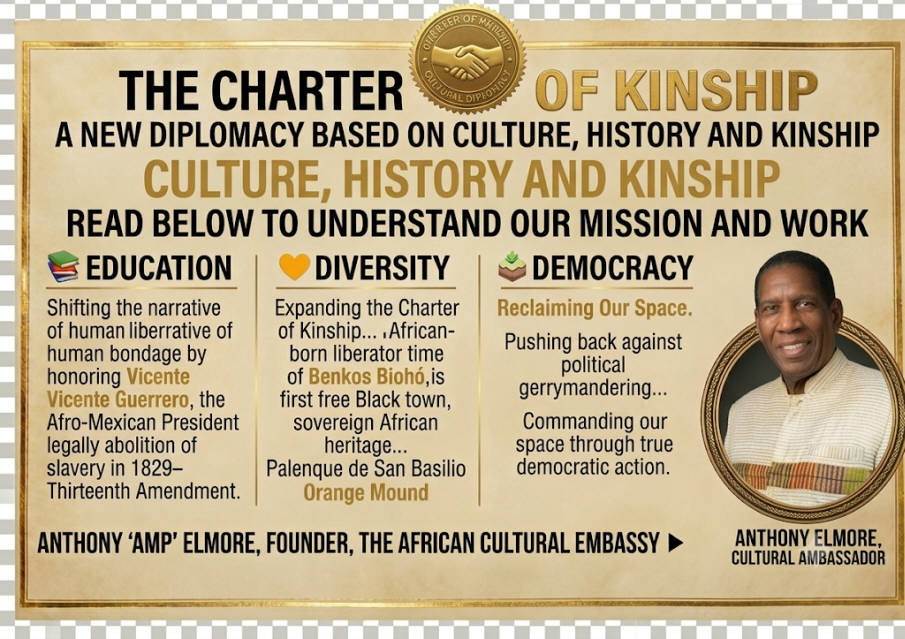
The Charter of Kinship: A New Frontier in Cultural Diplomacy
The **Charter of Kinship** is a revolutionary, sovereign diplomatic framework pioneered by the **African Cultural Embassy** in Orange Mound, Memphis, Tennessee. It represents a bold shift away from standard, hollow political networking, replacing transactional foreign policy with a deep, permanent alliance rooted in shared culture, un-sanitized history, and ancestral family ties.
When we ask nations to sign the **Charter of Kinship**, we are not executing a political treaty; we are signing official letters of kinship that formally recognize our relationship as a transnational family. It is a natural bond that cannot be contained by municipal maps or politically gerrymandered legislative lines.
Why It Is Not Political, But Cultural
Traditional diplomacy is bound by governments, changing regimes, and corporate contracts. The Charter of Kinship belongs entirely to the people. By anchoring our alliances in the raw, undeniable historical victories of our ancestors, we establish a permanent cultural democracy. We do not ask the establishment for permission to connect; we claim our global inheritance across borderless continents.
Our Expanding Global Circle of Family
The African Cultural Embassy is actively issuing and signing the Charter of Kinship to unite the global African diaspora with the entire Hispanic world:
Click here to read the Charter of Kinship with Kenya:
Honoring our deep, foundational roots of continental heritage and community diplomacy.
* **The United Mexican States:** Centered on the legacy of North America's first Afro-Mestizo President, **General Vicente Guerrero**, who outlawed slavery in 1829 and opened the Southern Underground Railroad.
* **The Republic of Colombia:** Rooted in the royal resistance of **Benkos Biohó**, the African King who founded the first free Black town in the Americas (Palenque de San Basilio) in 1599, and connecting with modern grassroots leadership like Vice President Francia Márquez.
* **The Republic of Cuba and Beyond:** Reaching into the Caribbean to honor icons of Afro-descended liberation like **General Antonio Maceo** (The "Bronze Titan").
By lifting each other up, cleansing the toxic stereotypes imposed by mainstream corporate media, and writing our own histories in multiple languages, the Charter of Kinship proves that our educational and cultural destiny is truly borderless.
EL ESTATUTO DE HERMANDAD (VERSIÓN EN ESPAÑOL)
El Estatuto de Hermandad: Una Nueva Frontera en la Diplomacia Cultural
El **Estatuto de Hermandad** (*The Charter of Kinship*) es un marco diplomático soberano y revolucionario creado por la **Embajada Cultural Africana** en Orange Mound (Memphis, Tennessee). Representa un cambio audaz frente a las relaciones políticas tradicionales y vacías, reemplazando la diplomacia transaccional por una alianza profunda y permanente arraigada en la cultura compartida, la historia sin censuras y los lazos familiares ancestrales.
Cuando invitamos a las naciones a firmar el **Estatuto de Hermandad**, no estamos ejecutando un tratado político; estamos firmando cartas oficiales de parentesco que reconocen formalmente nuestra relación como una familia transnacional. Es un vínculo natural que no puede ser contenido por mapas municipales ni por líneas legislativas amañadas por el sistema político.
Por Qué No Es Político, Sino Cultural
La diplomacia tradicional está limitada por los gobiernos, los cambios de régimen y los contratos corporativos. El Estatuto de Hermandad pertenece enteramente al pueblo. Al anclar nuestras alianzas en las victorias históricas puras e innegables de nuestros antepasados, establecemos una verdadera democracia cultural. No pedimos permiso al sistema para conectarnos; reclamamos nuestra herencia global a lo largo de continentes sin fronteras.
Círculo Familiar Global en Expansión
La Embajada Cultural Africana está emitiendo y firmando activamente el Estatuto de Hermandad para unir a la diáspora africana global con todo el mundo hispano y latinoamericano:
* **La República de Kenia:** Honrando nuestras raíces profundas y fundamentales de herencia continental y diplomacia comunitaria.
Los Estados Unidos Mexicanos:** Centrados en el legado del primer presidente afro-mestizo de Norteamérica, el **General Vicente Guerrero**, quien abolió la esclavitud en 1829 y abrió el Ferrocarril Subterráneo del Sur.
* **La República de Colombia:** Enraizados en la resistencia soberana de **Benkos Biohó**, el rey africano que fundó el primer pueblo libre de negros en las Américas (Palenque de San Basilio) en 1599, y conectando con líderes afrocolombianos de base como la Vicepresidenta Francia Márquez.
* **La República de Cuba y Más Allá:** Expandiendo nuestros lazos hacia el Caribe para honrar a los titanes de la liberación afrodescendiente como el **General Antonio Maceo** (El "Titán de Bronce").
Al apoyarnos mutuamente, desmantelar los estereotipos tóxicos impuestos por los medios de comunicación corporativos y escribir nuestras propias historias de forma bilingüe, el Estatuto de Hermandad demuestra que nuestro destino educativo y cultural es verdaderamente ilimitado.
